 By Chuck Jelly ·
 By Chuck Jelly ·
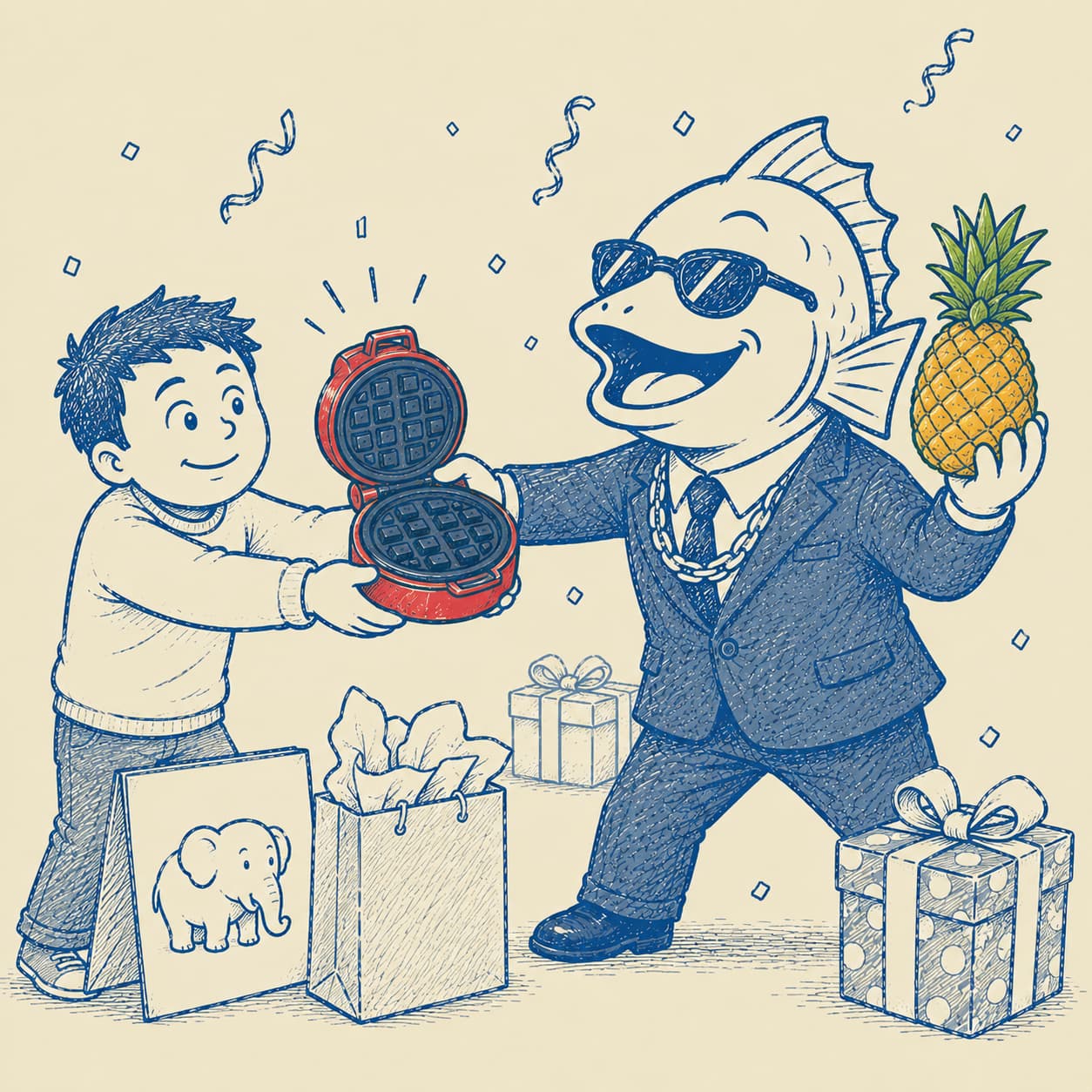
One pile of gifts, endless surprises. Learn how White Elephant works, the stealing rules, what to bring at every budget, and how to host one everyone enjoys.
A White Elephant gift exchange starts with a pile of wrapped presents and ends with at least one person clutching a waffle maker like it's the last lifeboat off the Titanic, muttering, "No. Mine now."
This is not a normal gift exchange. Nobody shops for a specific person. Everyone throws one wrapped gift into a shared pile, and then, in an order decided by pure chance, people take turns either opening something new or straight-up stealing a gift someone else already unwrapped.
Part party game. Part gift exchange. Part small-claims court over a novelty mug.
White Elephant shows up most around the holidays, but it works just as well for office parties, family gatherings, birthdays, fundraisers, or a random Tuesday when your friend group decides regular gift-giving has gotten boring.
Depending on where you’re from, you might know White Elephant as Yankee Swap or Dirty Santa: same chaos, different name. (Source: Wikipedia, White elephant gift exchange)
Worth checking which version your group means before you show up with a tastefully wrapped fruit basket to an event built entirely around competitive gift theft.
Three ingredients make a White Elephant exchange:
Nobody's gift is assigned to a person. That's the big difference from Secret Santa.
In Secret Santa, where group members are randomly assigned someone to give a gift to, you shop for one specific human and try to get it right. In White Elephant, you bring one gift and then watch, slightly nervous, as an entire room decides in real time whether your present is genius, ridiculous, or, best case, both.
The best gifts get a very specific two-part reaction:
"That's hilarious."
Immediately followed by:
"Wait, can I have it?"
The basic version is simple. It only gets complicated once someone tries to steal the same waffle maker for the fourth time and a debate breaks out about whether that's even allowed.
Each person brings one anonymous, wrapped gift, usually within a price limit the host sets in advance. Pick a limit everyone is comfortable with; any group can choose its own number.
Pile the gifts somewhere everyone can see them, unlabeled. The entire point is that nobody knows who brought what. You can number them for organization, but if every box looks identical, you've built a discount treasure hunt.
Everyone draws a number for turn order. Player one goes first, player two goes next, and so on down the line.
This is the moment everyone pretends to be thrilled with whatever number they got.
Player one gets first dibs on a completely unknown pile. The last player gets the least suspense but the widest selection of already-unwrapped gifts to choose from.
The first player grabs a wrapped gift and opens it for the whole room to judge.
This is a risky moment. It could be excellent. It could be deeply disappointing. It could be an object so strange that the entire room starts asking, out loud, "Who makes this?"
Whatever it is, it's now fair game for stealing.
On each turn, a player can either:
If your gift gets stolen, you immediately go again: open something new, or steal from someone else in turn. Most groups don't let you steal back the exact gift that was just taken from you. Otherwise two people would spend the whole night lobbing a blanket back and forth while everyone else moves on to the snack table.
The round continues until everyone's had a turn and every present is unwrapped. Many groups then give player one, who had the fewest options at the very start, one final chance to swap their current gift for any unfrozen one in the room. Decide in advance whether this rule applies. Announcing it after player one has already started their closing argument tends to go badly.
Confusion is the enemy of a good White Elephant night. Nail these down first:
This sounds like a lot of admin for a party game. It is not. It just means fewer people will suddenly discover a passion for rules-lawyering the moment their favorite gift is on the line.
Once a gift has been stolen a set number of times, it freezes and can't be taken again. Two steals is commonly used, and some groups use three (source: Wikipedia), and a rare few seem to believe the game should continue until nobody remembers why they came. A cap keeps things competitive without letting one cursed gnome statue circle the room forever.
If someone steals your gift, you can't steal it straight back. You have to open something new or steal from someone else instead. Without this rule, two people can turn the whole exchange into a private auction while everybody else watches, bored, holding a plate of cheese.
Because player one had zero opened gifts to choose from when they went first, plenty of groups give them one last shot: keep their current gift, or trade it for any unfrozen gift in the room. This rule is extremely satisfying when player one unwrapped a questionable ceramic duck first and gets to trade up at the very end.
A good White Elephant gift is surprising, funny, and just desirable enough that someone in the room wants to fight for it. The strongest picks usually land in one of three buckets.
Practical enough to want, unusual enough to notice:
These gifts start quiet. Ten minutes later, three different people are inexplicably reading the box like it holds the last useful object on Earth.
A good gag gift earns a laugh without earning a one-way ticket to the donation bin:
The ideal reaction:
"I would never buy this myself."
"...Unless somebody else grabs it first."
The true champions of the pile:
You're not aiming for the strangest object in the store. You're aiming for something that gets a laugh, then makes people calculate whether stealing it would look too obvious.
Interesting snacks, novelty socks, a funny mug, hot sauce, a small card game, a notebook, a desk toy, a chocolate selection, a reusable bag with a slightly questionable slogan.
A board game, a travel mug, a compact kitchen appliance, a themed food basket, a cozy blanket, a small speaker, a gift card, a quality water bottle, a candle (if the room's comfortable with scented gifts).
A theme makes shopping easier and keeps the gift pile from turning into a random museum of mugs. Try:
Keep the theme clear enough to guide people, but not so strict that guests need a twelve-page interpretation memo to shop.
An office exchange should stay playful without getting personal.
Good picks: coffee or tea, snacks, a desk plant, a notebook, a phone stand, a reusable water bottle, a funny-but-usable mug, a small speaker, a gift card, a puzzle or card game, a cable organizer, a local food product.
Skip: anything about someone's appearance, strong political or religious jokes, sexual humor, alcohol unless the whole group's on board, strongly scented products, anything that could embarrass a colleague, or an inside joke that excludes everyone except two people.
The goal is laughter around the break room table, not a follow-up meeting titled "Quick chat."
Friends and relatives usually allow for a lot more creative freedom. Consider a theme built around:
A strange object with an actual family story attached can beat anything bought new. Someone's ancient fondue set. A 1998 holiday ornament. A mug with a slogan nobody can fully explain. Any of these can become the single most fought-over item of the night.
Still, read the room. Some families love deliberately awful gifts. Others would rather the presents be funny without requiring an emergency trip to the recycling bin the next morning.
Hosting doesn't require a full entertainment program. Once the first gift gets stolen, the room runs itself.
Before the exchange, tell guests:
One gift per person is the simplest setup. For a large group, split into smaller pods so the game doesn’t outlast dessert.
During the exchange: arrange seating so everyone can see the pile, and prep numbers in a bowl, hat, or randomizer app. Keep track of whose turn it is, who's currently holding what, how many times each gift's been stolen, which gifts are frozen, and whether the final swap is still available. Paper works. A phone note works too. This is not a moment that needs a project-management platform.
After the exchange, hand out a few informal awards: funniest gift, most-stolen gift, worst gift, best wrapping, most suspicious packaging, gift nobody wanted until the last five minutes, and most dramatic reaction. That last one should go to whoever said "I don't even want this" while hugging the gift with both arms and refusing to set it down.
It’s mostly luck, but there's just enough strategy in the mix to make everyone feel like a chess grandmaster for one evening.
Watch what people keep looking at. The first laugh isn't always the real signal. Notice what people's eyes drift back to after the initial joke's worn off. That's usually the gift with staying power.
Don’t overreact. Announce you hate a gift, and somebody may decide it's secretly brilliant just to spite you. Announce it's the best thing you've ever seen, and someone may steal it purely to investigate. A neutral face is a surprisingly strong strategy.
Remember the turn order. Early players have less information but first pick. Late players have more choice but less mystery. That imbalance is exactly why the player-one final swap rule tends to make the whole game feel fairer.
Know when to stop pushing your luck. If your gift is frozen, relax and keep it. If your favorite item's already been stolen three times, it's probably locked. And if your current gift is good, don't trade it away for a mystery box just because the box has nicer wrapping paper. Mystery is powerful. So is regret.
Bringing something unpleasant. Funny is good. Broken, offensive, or "technically legal, I checked" is not. If your gift needs a disclaimer before anyone opens it, pick a different gift.
Ignoring the budget. The spending limit is what keeps the whole thing fair. One luxury item in a $15 exchange makes everyone else uncomfortable, even if it's objectively a great gift, and it can turn the night into a financial arms race nobody signed up for.
Explaining the rules halfway through. Set the steal limit and the final-swap rule before the first gift is opened. Changing the rules once your favorite present is on the line is lobbying, not strategy.
Allowing unlimited steals. Without a cap, the game slows to a crawl and one object becomes the unofficial property of the evening. A two- or three-steal limit creates plenty of chaos without turning into a hostage situation.
Taking the stealing personally. Nobody is rejecting you. They are stealing your electric blanket because it is, in fact, an excellent electric blanket.
Two very different flavors of holiday chaos:
| White Elephant | Secret Santa | | --- | --- | | Everyone contributes to one shared pile | Each person shops for one assigned recipient | | Gifts can be stolen | Gifts are given directly, no theft involved | | Competitive and unpredictable | Personal and planned | | Gifts can be funny, strange, useful, or second-hand | Gifts are chosen with one specific person in mind | | You don't know who'll end up with your gift | You know exactly who your gift is for | | The main event is the swapping | The main event is the reveal |
Pick White Elephant when you want reactions, light chaos, and a little strategy. Pick Secret Santa when the group would rather put real thought into one carefully chosen gift for one specific person.
White Elephant works because it turns an ordinary pile of gifts into a live event.
A wrapped box becomes a mystery. A mug becomes a bargaining chip. A blanket becomes a family heirloom for roughly eleven minutes before someone steals it back.
The best gift in the room is the one that gets a laugh, builds a little suspense, and gives at least one person a reason to lean forward and say:
"Actually. I'll take that."
Stay within budget. Learn the house rules.
And accept, going in, that your gift might get stolen by someone who’s shown zero interest in it up to that exact moment.
If your present gets taken three times?
Congratulations, that is market validation. Good luck, and have fun!
A White Elephant gift exchange is a group gift game where everyone brings one wrapped, unassigned gift, and players take turns opening new presents or stealing ones that have already been unwrapped. Unlike a typical gift exchange, nobody's gift is meant for a specific person: the fun is in not knowing where yours will end up.
In Secret Santa, each person is secretly assigned one recipient and shops specifically for them, and gifts are given directly with no stealing involved. In White Elephant, gifts go into a shared pile with no assigned owner, and the entire format is built around opening and stealing. Secret Santa is more personal and planned; White Elephant is more competitive and unpredictable.
Everyone contributes one wrapped gift to a shared pile, then draws a number for turn order. Player one opens a gift, and every player after that can either unwrap something new or steal an already-opened gift from someone else. The round continues until every gift is open and everyone's had a turn.
There’s no single official rulebook: most of it comes down to what your group agrees on beforehand: the spending limit, whether stolen gifts can be stolen back immediately, how many times one gift can be stolen before it's frozen, and whether player one gets a final swap. Settling these before the first gift is opened avoids most of the arguments.
Most groups cap it at two or three steals, after which the gift "freezes" and can't be taken again. Without a limit, one popular item can circle the room indefinitely while everyone else waits around holding cheese and crackers.
Most exchanges set a budget somewhere between $10 and $25, though it's entirely up to the group. What matters more than the exact number is that everyone sticks to it: one noticeably expensive gift in a low-budget exchange tends to make the whole game feel unbalanced.
White Elephant is great for chaos. It’s not so great for getting what you want.